- No Products In The Cart
- start shopping





House of Stoves • Advice & inspiration
Storage Heaters or Panel Heaters: Which Suits Your Home?
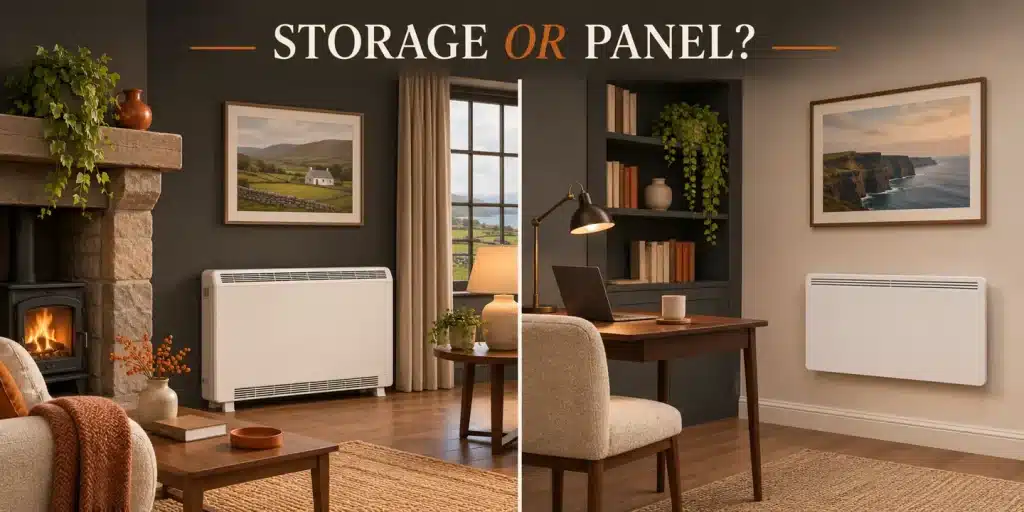
A sitting room used all day needs a different heating plan from a spare bedroom warmed for the occasional guest. Before choosing a storage heater or a panel heater, look at when you need warmth, how the room holds heat and the electricity tariff you actually pay.
The short answer
A storage heater stores heat for later use; a panel heater produces heat when it draws electricity. Storage heating is worth comparing for regular daily use with a suitable off-peak tariff. A panel heater can suit shorter or less predictable heating periods. Neither is automatically the cheaper choice for every home.
How the two types work
A storage heater charges a heat-retaining core and releases that heat later. Modern controls can manage the charge and the times when warmth is delivered, so it is worth looking beyond the experience of an older heater with simple input and output dials.
A panel heater is direct acting: it uses electricity to warm the room during the heating period. That makes it a useful option when the time you need heat varies. The thermostat and programme still matter—you do not want it warming an empty room unnecessarily.
SEAI’s explanation of direct electric and storage heating (PDF) describes how stored heat can be released later. The important cost difference is when you buy the electricity and how usefully you manage the resulting heat.
| Your decision | Storage heater | Panel heater |
|---|---|---|
| When heat is made | During charging, ready for later use. | While it is drawing power to heat the room. |
| A useful starting point | Rooms needing warmth regularly, with a suitable charging tariff. | Rooms used for shorter or changing periods. |
| What to check first | Charging hours, tariff, storage capacity and electrical arrangement. | Required output, programme and tariff during use. |
| What both need | Correct sizing and model-specific installation. | Correct sizing and model-specific installation. |
Start with your electricity plan
Take out a recent bill and check the unit rates and the hours they cover. Then ask whether the proposed heater’s charging schedule works with that plan. A low advertised overnight rate is only useful if the heater can charge as intended during those hours.
Do not assume every Irish night-rate or smart plan works in the same way, or use UK Economy 7 hours to programme an Irish installation. Your supplier can confirm the tariff; your electrician should confirm the supply and control arrangement. ESB Networks’ meter guidance is a useful reference if you are changing or checking a meter.
Compare running costs using kWh, not the model number
The basic calculation is electricity used in kWh × the applicable price per kWh. If different rates apply, calculate each period separately.
For illustration only, 10kWh at €0.20/kWh costs €2; 10kWh at €0.35/kWh costs €3.50. These are assumed rates, not a current tariff quote or a forecast for your home. They show why the timing of electricity use matters.
They do not prove that two heaters will use the same amount of electricity in practice. Room heat loss, the temperature you choose, charging, controls and any daytime boost all affect the bill. A heater described as “1kW output” is not necessarily drawing just 1kW while charging: storage capacity, charge input and heat output are different figures.
Where Quantum, XLE and PLXE fit
Dimplex Quantum RF is a high heat retention storage range with charge management and programmable controls. It is worth considering when you want stored heat managed around a regular routine. See the Quantum QM100RF at HOS and Glen Dimplex Ireland’s Quantum information. Choose the size from the room requirement, not the range name.
Dimplex XLE is another storage option, with a different heat-retention specification from Quantum. The XLE100 is part of our range. Its manufacturer specifies peak and off-peak supplies; your electrician should check the proposed installation against the supplied instructions. Read the manufacturer’s XLE100 details before comparing.

Dimplex PLXE is a wall-mounted panel range with onboard programming. Optional app control requires the compatible additional hardware, sold separately. Compare the output choices on our PLXE product page with Dimplex’s PLXE specification.
Choose for the room you actually use
For a living room occupied most days, compare a correctly sized storage heater with your available off-peak plan. For an occasional guest room, look carefully at a panel heater’s programme and the cost of heating only when needed. A home office used five days a week deserves its own comparison rather than automatically being treated as an occasional room.
Floor area is only part of sizing. Ceiling height, insulation, glazing, external walls and adjoining spaces change the requirement. For example, a well-insulated 21m² room and a draughty room of the same size should not automatically receive the same recommendation.
A warmer room starts with the right information
Let’s narrow down the options
Send us your room dimensions, when you use it, details of the existing heater and your electricity plan. We can help compare our storage heaters and panel heaters.
Talk to our Kilkenny team or call 087 376 9540.
HOS is retail only and does not provide installation services. Arrange your own qualified electrician to confirm the heating requirement, electrical suitability and installation.